


Introduction
The way people consume magazine-style content has changed dramatically.
Readers once depended on printed publications for articles, interviews, reviews, lifestyle ideas, technology updates, and educational information. Today, the same types of content can be discovered through search engines, social networks, newsletters, recommendation systems, and online publishing platforms.
This shift has created a much larger digital publishing ecosystem.
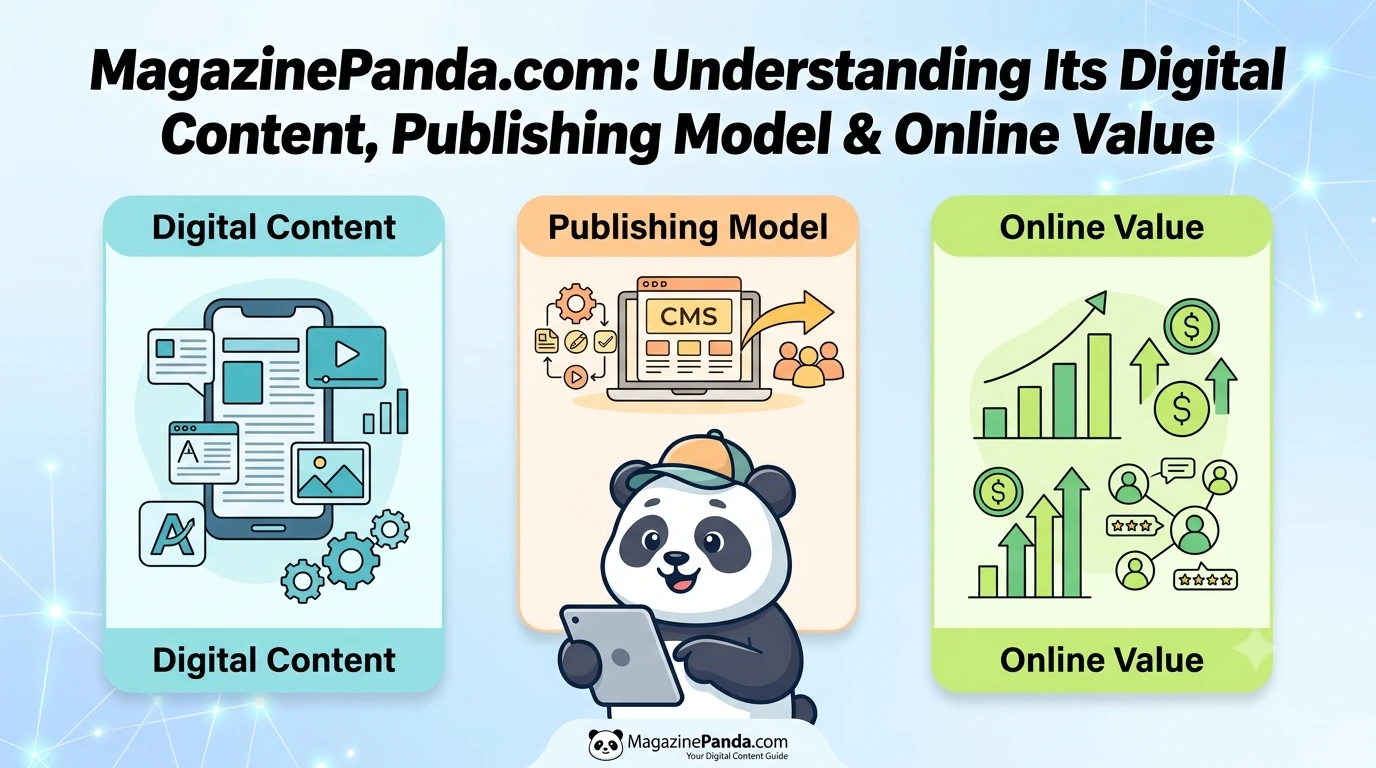
MagazinePanda.com is a name associated with this broader online publishing environment, where readers can encounter magazine-style articles and information across different subjects.
Current public references describe MagazinePanda-related publishing as broad rather than focused on a single niche. The accessible MagazinePanda-branded website highlights diverse topics, including lifestyle and technology, as well as analyses and reviews.
At the same time, the exact current relationship between the requested magazinepanda.com domain and other similarly named MagazinePanda properties is not completely clear from publicly accessible evidence. The requested domain also returned a 403 response when directly accessed during this research.
That distinction matters.
Instead of assuming that every claim found online belongs to the same website, it is better to look at MagazinePanda through the wider lens of digital publishing, content discovery, editorial quality, SEO, audience value, and online credibility.
What Is MagazinePanda.com?
MagazinePanda.com can be understood in the context of online magazine-style publishing and multi-topic digital content.
A digital magazine differs from a traditional print publication because content can be:
- Published continuously
- Updated after publication
- Linked to related articles
- Shared through social platforms
- Discovered through search
- Combined with multimedia
- Accessible from different devices
The accessible MagazinePanda-branded website presents itself as a platform offering articles and blogs across multiple subjects and emphasizes quality, accessibility, and reader engagement.
However, because the exact requested domain could not be fully accessed, readers should verify current categories and site-specific claims directly on the live domain before treating them as confirmed.
MagazinePanda at a Glance
| Area | Overview |
|---|---|
| Brand discussed | MagazinePanda |
| Requested domain | MagazinePanda.com |
| Content model | Digital publishing / magazine-style content |
| Topic approach | Broad, multi-topic publishing |
| Potential audience | General online readers |
| Content formats | Articles, guides, reviews, analyses, lifestyle content |
| Primary discovery channels | Search, direct visits, social sharing, recommendations |
| Important consideration | Evaluate individual articles and current site information |
The accessible MagazinePanda-branded material specifically describes diverse topics, analyses and reviews, lifestyle content, and community interaction as parts of its publishing proposition.
Why Digital Magazine Websites Matter
Digital magazines occupy an interesting position between traditional publishing and modern content websites.
They can combine:
- Editorial storytelling
- Search-friendly articles
- Visual content
- Practical guides
- Reviews
- Commentary
- Educational material
- Lifestyle information
This creates a flexible publishing environment.
A reader might discover an article through Google, share it on social media, return through a bookmark, and later explore another category.
That ability to create multiple entry points is one of the biggest advantages of digital publishing.
MagazinePanda and the Changing Reading Experience
The modern reader expects information to be available quickly.
Instead of waiting for a monthly issue, readers can search for a subject whenever they need it.
For example, someone interested in technology might search:
“Latest smartphone display technology”
Another reader might search:
“How to improve productivity at home”
Someone else could search:
“Best travel planning tips”
A broad online magazine can potentially serve all three readers.
But this creates a challenge.
Different subjects require different levels of expertise.
A general lifestyle article may require relatively straightforward research.
A financial, medical, legal, or technical article may require considerably stronger sourcing and specialist review.
Breadth Is Not the Same as Expertise
A multi-topic website has an obvious advantage:
Variety.
Readers can explore different subjects without visiting multiple sites.
But variety also creates a question about authority.
Consider two publications.
Publication A
Focuses entirely on technology.
Publication B
Publishes technology, finance, health, travel, education, business, and lifestyle articles.
Publication B may have broader coverage.
Publication A may have greater topical depth.
Neither model is automatically better.
The key question is whether the publication demonstrates the appropriate expertise and editorial standards for the subjects it covers.
What Readers Should Look for in MagazinePanda Articles
A reader evaluating an article should ask several simple questions.
Who wrote it?
A named author provides more transparency than anonymous content.
When was it published?
Older information may need updating.
Has it been updated?
This is especially important for technology and other rapidly changing subjects.
Are sources provided?
Important claims should be supported.
Is the article factual or opinion-based?
Readers should understand the difference.
Does the article answer the question?
An article should provide useful information rather than simply repeat keywords.
These checks are useful for MagazinePanda and virtually every other online publication.
MagazinePanda and Content Discovery
Search engines remain one of the most important ways readers discover digital articles.
But users generally do not search for a publication first.
They search for a problem.
For example:
- What is digital publishing?
- How does artificial intelligence work?
- How can I improve my work routine?
- What are the benefits of online learning?
- How do I choose a travel destination?
If an article answers the question effectively, the publication can become part of the reader’s discovery journey.
This is why search intent should be central to digital content strategy.
Understanding Search Intent
There are four useful categories of search intent.
Informational Intent
The reader wants an answer.
Example:
“What is digital publishing?”
Navigational Intent
The reader wants a particular website or brand.
Example:
“MagazinePanda.com”
Commercial Investigation
The reader wants to compare options.
Example:
“Best digital publishing platforms”
Transactional Intent
The reader is ready to take an action.
Example:
“Submit article to online magazine”
A strong publishing strategy can create content for each stage.
MagazinePanda and Reader-Friendly Content
Online readers often scan an article before deciding whether to continue.
That means structure matters.
Useful formatting includes:
- Short paragraphs
- Descriptive headings
- Bullet points
- Tables
- Bold key ideas
- Examples
- FAQ sections
- Clear conclusions
A good article should allow a reader to find the basic answer quickly while still offering deeper information for those who want it.
Why Headlines Matter
The headline is often the first thing a reader sees.
A strong headline should communicate:
Topic + benefit + curiosity
For example:
Weak:
“Digital Publishing”
Better:
“How Digital Publishing Is Changing the Way People Discover Information”
The second title gives readers a clearer reason to continue.
However, the headline must accurately represent the article.
Clickbait may generate attention, but misleading readers can reduce long-term trust.
MagazinePanda and Long-Form Content
Long-form content is useful when a subject requires explanation.
A detailed article can include:
- Direct answer
- Background
- Main concepts
- Examples
- Benefits
- Limitations
- Practical advice
- FAQs
- Conclusion
But longer does not automatically mean better.
The goal should be:
Complete enough to satisfy the reader, but concise enough to respect their time.
Evergreen Content: A Long-Term Opportunity
One of the strongest content types for digital publishers is evergreen content.
Evergreen articles answer questions that remain relevant.
Examples include:
- Beginner guides
- Definitions
- Tutorials
- Checklists
- How-to articles
- Educational explainers
For example:
“What Is Digital Marketing?”
may remain useful for years.
By contrast:
“Digital Marketing Trends This Week”
has a much shorter lifespan.
A balanced publication can use both.
Trending Content and Evergreen Content
The two formats serve different purposes.
| Trending Content | Evergreen Content |
|---|---|
| Current | Long-lasting |
| Time-sensitive | Durable |
| Can attract quick attention | Can attract recurring search traffic |
| Often needs fast publishing | Needs periodic updating |
| Useful for discovery | Useful for education |
The strongest strategy is often to connect them.
For example:
Trending topic: A major AI announcement.
Evergreen article: A beginner’s explanation of generative AI.
The trending article creates immediate interest.
The evergreen guide provides background.
MagazinePanda and Topic Clusters
A publication can become more useful by connecting related articles.
Imagine a technology content cluster.
Main Topic
Understanding Modern Technology
Supporting Articles
- What Is Artificial Intelligence?
- How Cloud Computing Works
- What Is Digital Privacy?
- Cybersecurity Basics
- How Automation Works
- Technology Trends to Watch
Each article supports the others.
This creates a stronger content library than publishing unrelated topics without connections.
Why Internal Linking Matters
Internal links help readers move from one relevant article to another.
For example:
An article about AI productivity could link to:
- AI basics
- AI automation
- AI tools
- AI workplace trends
This creates a logical journey.
It can also help search engines understand the relationships between pages.
The most effective internal links are natural and useful rather than inserted simply for SEO.
MagazinePanda and E-E-A-T
E-E-A-T stands for:
Experience, Expertise, Authoritativeness, and Trustworthiness.
These concepts are especially important for broad digital publications.
Experience
Does the writer demonstrate relevant first-hand experience?
Expertise
Does the author understand the subject?
Authoritativeness
Does the publication have credible evidence supporting its claims?
Trustworthiness
Is the information transparent, accurate, and responsibly presented?
The importance of these signals varies by topic.
For example, a personal lifestyle article may rely heavily on experience.
A medical article requires considerably stronger expertise and sourcing.
Why Author Pages Matter
Readers should be able to understand who created the information.
A useful author profile can include:
- Name
- Professional background
- Areas of expertise
- Relevant experience
- Published work
- Professional credentials where appropriate
This gives readers a basis for evaluating the article.
It also makes the publication feel more accountable.
The Importance of Sources
Not every sentence needs a citation.
But important claims should be supported appropriately.
This is especially important for:
- Statistics
- Scientific claims
- Medical information
- Financial information
- Government policies
- Technical specifications
- Market data
- Historical claims
A good source should actually support the claim being made.
Simply adding links does not automatically make an article trustworthy.
MagazinePanda and AI-Assisted Content
Artificial intelligence has transformed content production.
AI can help publishers with:
- Brainstorming
- Outlining
- Research organization
- Summarization
- Translation
- Editing
- Repurposing
But AI also creates risks.
Generated material may contain:
- Incorrect facts
- Outdated information
- Repetitive explanations
- Unsupported claims
- Missing context
Therefore, AI should support—not replace—editorial judgment.
A Responsible AI Publishing Workflow
A useful process is:
1. Research
Collect reliable information.
2. Plan
Define the audience and purpose.
3. Draft
Create the article using appropriate tools.
4. Verify
Fact-check important claims.
5. Edit
Improve clarity and originality.
6. Review
Check sources, links, formatting, and accuracy.
7. Publish
Make the content accessible.
8. Update
Review important information when circumstances change.
This workflow makes AI a productivity tool rather than a substitute for editorial responsibility.
MagazinePanda and Visual Storytelling
Online magazine content does not have to be text-only.
Relevant images can:
- Introduce an article
- Explain a concept
- Provide context
- Improve scanning
- Break up long sections
Infographics can simplify:
- Statistics
- Comparisons
- Processes
- Timelines
Videos can demonstrate:
- Tutorials
- Products
- Interviews
- Workflows
- Educational concepts
The key is relevance.
A visual should help readers understand the subject.
Mobile-First Content
Digital magazines also need to consider smartphone readers.
A mobile-friendly article should have:
- Readable typography
- Comfortable spacing
- Responsive design
- Clear navigation
- Fast-loading media
- Short paragraphs
- Easily accessible links
A reader should not need to zoom or struggle with the page layout.
MagazinePanda and Content Repurposing
One strong article can become multiple content assets.
For example:
Original Article
How Digital Publishing Is Changing
Social Post
Three major changes in online publishing.
Video
A five-minute explanation of the topic.
Infographic
Digital publishing explained visually.
Newsletter
Key insights and takeaways.
FAQ
Answers to common reader questions.
Repurposing allows publishers to reach different audiences without creating a completely new idea every time.
What Makes Digital Content Valuable?
Useful content generally does one or more of the following:
Explains
Makes a difficult topic easier to understand.
Solves
Helps the reader overcome a problem.
Compares
Helps the reader evaluate alternatives.
Guides
Shows the reader what to do next.
Informs
Provides useful background.
Inspires
Introduces a new perspective or possibility.
This is more important than simply achieving a particular word count.
MagazinePanda and Content Quality
A publication should focus on reader value rather than article volume.
High-quality content generally has:
- A clear purpose
- Accurate information
- Relevant examples
- Appropriate depth
- Original insights
- Strong organization
- Useful sources
- Natural language
An article can be perfectly optimized for search and still be disappointing if it does not actually answer the reader’s question.
Common Problems in Digital Publishing
Publishing Too Broadly
A website can lose focus if it tries to cover everything.
Thin Articles
Short articles may fail to provide enough information.
Generic Content
Repeating information found everywhere adds little value.
Weak Author Transparency
Readers may struggle to evaluate expertise.
Outdated Information
Old articles can become misleading.
Excessive Keyword Optimization
Overusing keywords makes writing unnatural.
Unverified Claims
Unsupported statements can damage credibility.
Over-Reliance on AI
Automation without editorial review can reduce quality.
How to Evaluate MagazinePanda.com
If you are researching MagazinePanda for reading, publishing, or SEO purposes, use a practical evaluation process.
Check the Current Website
Look at the live content rather than relying exclusively on third-party descriptions.
Review the Authors
See whether writers are identified and whether their expertise is relevant.
Examine the Content
Look for originality, depth, and useful information.
Check Publication Dates
Determine whether articles appear current.
Review Sources
Look for credible references behind important claims.
Evaluate the Audience
Ask whether the publication’s readers match your subject.
Assess Editorial Transparency
Look for About, Contact, Privacy, Terms, and editorial information.
Because the requested domain was not accessible to the research crawler, current site-specific claims should be independently verified before using the website for important decisions.
MagazinePanda and SEO Opportunities
If a marketer is considering MagazinePanda for content placement or SEO, domain-level metrics should not be the only consideration.
Evaluate:
Topical Relevance
Does the website genuinely cover your subject?
Audience Relevance
Would the readers care about your article?
Organic Visibility
Does the site currently receive meaningful search visibility?
Editorial Quality
Are articles useful and well researched?
Link Context
Would your link appear naturally within relevant content?
Page-Level Value
Would the individual article attract the right audience?
A backlink from an irrelevant website may provide little practical value even if the domain has attractive third-party metrics.
Why SEO Metrics Can Be Misleading
SEO tools can report:
- Domain Rating
- Domain Authority
- Backlinks
- Estimated traffic
- Keyword rankings
These metrics are useful for research.
But they are not proof of:
- Reader trust
- Editorial quality
- Expertise
- Audience relevance
- Actual business value
A marketer should combine quantitative data with qualitative evaluation.
MagazinePanda and Guest Publishing
If a website accepts external content, contributors should prioritize relevance.
A good guest article should:
- Fit the publication
- Match its audience
- Provide original information
- Avoid excessive promotion
- Use natural links
- Follow editorial requirements
Before submitting, writers should confirm:
- Whether submissions are currently open
- Whether links are allowed
- Whether publication is paid or free
- Who owns the content
- Whether edits are permitted
- Whether content can be removed later
Never assume these policies based solely on third-party listings.
GEO: Making Content Understandable to AI Systems
Generative Engine Optimization, or GEO, focuses on making information easier for AI-powered systems to understand and retrieve.
Useful practices include:
- Clear definitions
- Direct answers
- Descriptive headings
- Structured sections
- Concise explanations
- Specific terminology
- Supporting evidence
- Self-contained answers
For example:
What Is MagazinePanda.com?
MagazinePanda.com is associated with a broad digital publishing and online magazine-style content model.
The article can then explain the publishing model, audience, content types, and considerations for evaluating reliability.
This structure benefits both readers and answer systems.
AEO: Answering Questions Directly
Answer Engine Optimization focuses on answering questions in a format that search and answer systems can easily understand.
A useful structure is:
Question → Direct Answer → Explanation → Example
For example:
What Is an Online Magazine?
An online magazine is a digital publication that distributes articles and other editorial content through websites and internet-based platforms.
Then provide:
- Examples
- Differences from print
- Content types
- Reader benefits
- Publishing challenges
This approach is simple and effective.
Building Trust in a Digital Publication
A publication can strengthen reader confidence through:
About Page
Explain the purpose and identity of the publication.
Author Profiles
Show who creates the content.
Editorial Standards
Explain how articles are researched and reviewed.
Corrections Policy
Show how errors are handled.
Contact Information
Give readers a way to reach the publication.
Privacy Policy
Explain data practices.
Terms of Use
Explain how the website should be used.
Advertising Disclosure
Clearly distinguish sponsored material from editorial content.
These elements create transparency.
The Future of Digital Magazine Publishing
Online publishing will continue to evolve.
Several trends are likely to shape the industry.
AI-Assisted Research
Publishers can organize and process information more efficiently.
Multimedia Articles
Text can be combined with video, audio, graphics, and interactive content.
Personalized Discovery
Readers increasingly receive information based on interests.
Search Beyond Traditional Search Engines
AI assistants, social platforms, recommendation systems, and community discussions are becoming additional discovery channels.
Original Experience
First-hand reporting and practical experience can become more valuable as generic content becomes easier to generate.
Greater Emphasis on Trust
Readers need better ways to identify reliable information.
The digital magazine of the future will therefore need more than publishing volume.
It will need quality, context, transparency, and audience understanding.
A Practical Publishing Framework for MagazinePanda-Type Websites
A strong digital publication can use this process:
Step 1: Understand the Audience
Identify who the content is intended for.
Step 2: Find Real Questions
Discover what readers genuinely want to know.
Step 3: Research
Use reliable and relevant sources.
Step 4: Define the Main Answer
Decide what readers should remember.
Step 5: Build the Structure
Organize the article logically.
Step 6: Write Clearly
Avoid unnecessary jargon and repetition.
Step 7: Add Evidence
Support important claims.
Step 8: Add Examples
Make ideas practical.
Step 9: Optimize
Improve headings, metadata, internal links, images, and page structure.
Step 10: Review
Check accuracy, originality, grammar, and readability.
Step 11: Publish
Make the article accessible across devices.
Step 12: Update
Refresh information when necessary.
Measuring Digital Publishing Success
A publication should evaluate performance according to its objective.
| Metric | What It Indicates |
|---|---|
| Impressions | Visibility |
| Clicks | Initial interest |
| Organic traffic | Search discovery |
| Engagement | Reader interaction |
| Time on page | Content consumption |
| Shares | Audience resonance |
| Returning visitors | Loyalty |
| Newsletter signups | Audience growth |
| Conversions | Desired actions |
Traffic is useful, but it is not the only measure of success.
A smaller audience that reads carefully, returns regularly, and takes meaningful actions can be more valuable than a large audience that leaves immediately.
MagazinePanda: Potential Strengths
Broad Content Potential
A multi-topic publication can appeal to different reader interests.
Flexible Publishing
Digital articles can be published and updated without print limitations.
Multiple Discovery Channels
Articles can potentially be found through search, social sharing, recommendations, and direct visits.
Content Repurposing
Long-form articles can become videos, newsletters, social posts, and visual content.
Beginner-Friendly Opportunities
General-interest publishing can make unfamiliar subjects more approachable.
MagazinePanda: Important Considerations
Current Domain Accessibility
The requested magazinepanda.com domain returned a 403 response during this research, so some current site-specific details could not be independently verified.
Multiple Similar Brand References
Several third-party pages discuss MagazinePanda, while an accessible MagazinePanda-branded site appears under a hyphenated domain. The relationship between these properties should not be assumed without direct confirmation.
Broad Topic Coverage
A broad content model requires strong editorial processes to maintain expertise across different subjects.
Third-Party Information
Some online reviews make SEO and traffic claims that can conflict with other sources. Such claims should be independently verified before making business decisions.
Frequently Asked Questions
What is MagazinePanda.com?
MagazinePanda.com is associated with the broader concept of online magazine-style and digital content publishing. Publicly accessible MagazinePanda-branded material describes a broad content model involving subjects such as technology, lifestyle, health, entertainment, reviews, and analyses.
What topics does MagazinePanda cover?
Public references associate MagazinePanda with a variety of subjects rather than a single niche. The accessible branded website specifically mentions lifestyle, technology, health, entertainment, reviews, analyses, and other diverse content areas.
Is MagazinePanda.com a reliable source?
Reliability should be evaluated at the article level. Readers should examine authorship, sources, publication dates, evidence, and editorial transparency, particularly when an article discusses health, finance, law, or other high-stakes subjects.
Is MagazinePanda.com useful for SEO?
Its SEO value should be evaluated using current evidence such as organic visibility, topical relevance, audience quality, page-level performance, and editorial standards. Third-party listings currently provide differing SEO estimates, so individual claims should be verified rather than treated as definitive.
Can I publish an article on MagazinePanda.com?
Submission and publishing policies should be confirmed directly with the relevant website. Writers should verify whether submissions are open, what links are permitted, whether content is paid or unpaid, and what editorial requirements apply.
Is MagazinePanda.com a traditional magazine?
It is more appropriate to view MagazinePanda in the context of digital magazine-style publishing rather than traditional print publishing. Online publications can publish continuously, update articles, and distribute content through search and digital channels.
How can I evaluate a MagazinePanda article?
Check who wrote it, when it was published or updated, whether important claims have supporting sources, whether the information is current, and whether the article clearly separates facts from opinions or promotional material.
What is the difference between MagazinePanda and a niche website?
A niche website normally concentrates on a specific subject, while a broad publication can cover several categories. The broad approach offers variety, but niche publications may have an easier path to demonstrating deep expertise in one particular field.
Final Thoughts
MagazinePanda.com sits within the broader transformation of magazine publishing from print-first media to an internet-first content environment.
The biggest advantage of digital publishing is flexibility.
Articles can be created, published, discovered, shared, updated, and repurposed without waiting for a new physical edition.
But accessibility also creates competition.
Readers have thousands of websites competing for their attention.
That means simply publishing more articles is not enough.
The publications that create lasting value are the ones that answer genuine questions, provide useful context, demonstrate appropriate expertise, and make important information easy to understand.
For readers, the best approach is simple:
Read. Question. Verify. Compare.
For writers, the goal should be to create useful content rather than simply produce another article.
For marketers, website relevance and genuine audience value should matter more than a single SEO metric.
For publishers, the future depends on combining:
Editorial quality + Search visibility + Human expertise + Technology + Trust.
MagazinePanda and similar digital publications operate in an environment where these factors increasingly overlap.
The future of online magazines will not belong simply to websites that publish the most content.
It will belong to publications that give readers a reason to discover, understand, trust, and return to their content.